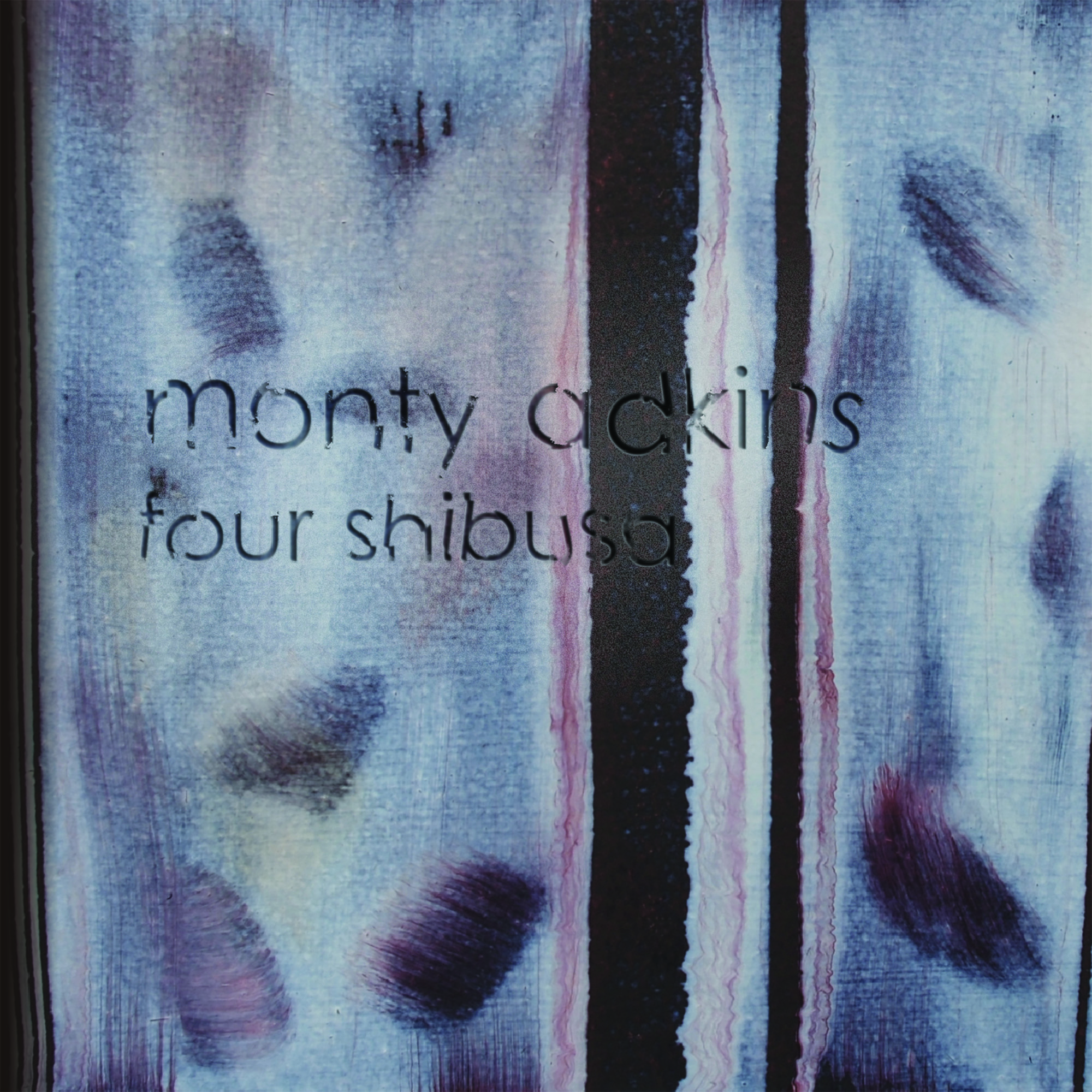
Four Shibusa
This studio album is the result of a year-long collaboration with the visual artist Pip Dickens and takes as its starting-point the Japanese concept of shibusa’ – a term that describes the inherent beauty in everyday objects. The surface simplicity of the music belies a real sophistication in sound design and meticulous balance between delicate evolving textures and melodic writing.



Tracklisting:
- sendai threnady
- entangled symmetries
- kyoto roughcut
- permutations
Monty Adkins
Monty Adkins is a composer and performer of experimental electronic music. He primarily creates digital audio works and installations. Since 2008, his sound works has become increasingly minimal and introspective, characterised by slow shifting organic instrumental and concrete soundscapes, focusing on encouraging a deeper immersive listening experience. Using a reduced sonic palette, he draws together elements from ambient, minimal electronica, acousmatic and experimental electronic music often combining instrumental and electronic sound.
His works have been performed at and commissioned by leading international festivals and institutions (including INA-GRM, IRCAM, BBC Radio 3, SpACE-Net, ZKM Karlsruhe, Sonic Arts Network, Visionas Sonoras, Bourges Festival, Akousma, IOU Theatre, and the Daiwa Anglo-Japanese Foundation) and released on labels worldwide including Audiobulb (UK), empreintes DIGITALes (Québec), Crónica (Portugal), Signature (France), Eilean (France), and LINE (USA).
Reviews
Ambient Blog
When I first read the title of Monty Adkins' latest album, "Four Shibusa" , I imagined a Shibusa would probably be some kind of exotic Japanese wind instrument. I was wrong: it turns out 'Shibusa' is a japanese concept 'describing the inherent simplicity and beauty in everyday objects'.
(Shibusa) "refers to a particular aesthetic of simple, subtle, and unobtrusive beauty, and can apply to a wide variety of subjects, not just art or fashion".
Shibui objects appear to be simple overall but they include subtle details, such as textures, that balance simplicity with complexity. This balance of simplicity and complexity ensures that one does not tire of a shibui object but constantly finds new meanings and enriched beauty that cause its aesthetic value to grow over the years. Shibui objects are not necessarily imperfect or asymmetrical, though they can include these qualities. Shibusa walks a fine line between contrasting aesthetic concepts such as elegant and rough or spontaneous and restrained. (Wikipedia - Shibui)
This description strikingly seems to apply to what most 'ambient' music tries to achieve...so there's a good start for further investigation!
My 'wind instrument' guess wasn't very far beyond the truth: the album opens with a strikingly beautiful clarinet duet, performed by Jonathan Sage and Heather Roche. The moment they start playing, it feels as if the surrounding world fades to the background, creating the right environment for the listener to focus on 'the beauty of everyday objects'.
It takes a while before Adkin's electronic details subtly start to shadow the clarinet parts. But his electronic details never seem to take over centre stage: they seem to be just there to support the haunting clarinet parts. And the Shibusa concept.
"More recently Monty Adkins' work has become increasingly minimal and introspective. this work focuses on encouraging a deeper immersive listening experience. working with a reduced sonic palette the new works draw together elements from ambient, minimal electronica, acousmatic (sound one hears without seeing an originating cause) and experimental electronic music."
The description of Shibusa perfectly matches the four tracks on this album, remaining true to this concept from the first to the very last note. Subtle details, balancing simplicity with complexity, sounds you never tire of listening to...."Four Shibusa " presents a perfect match of form and content. I hate to use this reviewer's cliché, but this is definitely one of the most beautiful albums I've have heard in a long time!
Blog Critics
Four Shibusa is Monty Adkins’ latest release for the Sheffield-based Audiobulb label, and it may well be his finest yet. The artist has been working in the electroacoustic music field for some time now, and is in fact a professor at England’s University of Huddersfield. His previous album, Fragile.Flicker.Fragment (2011) was pretty incredible. In fact, it has been nominated in the ‘album of the year’ category at the 2012 Qwartz Awards, Paris. As good as that recording was however, Four Shibusa is even more impressive.
As the title indicates, the disc contains four tracks, or Shibusa. The word “shibusa” is Japanese in origin, and describes the inherent simplicity and beauty in everyday objects. It is the perfect conceptual starting point for these pieces, which are the result of a year-long collaboration with the visual artist Pop Dickens that Monty Adkins has been involved in.
For those who may be unfamiliar with the term “electroacoustic music,” it is somewhat broad, and covers a wide range of sound experimentation. Some of the forms include musique concrete, computer music, tape music, basically electronic music of all sorts. Unlike last year’s Fragile.Flicker.Fragment however, Professor Adkins has included a great deal of traditional instrumentation in the music of Four Shibusa. The results are spellbinding.
The most notable addition to Monty’s musical palette are the clarinets of Jonathan Sage and Heather Roche. There can be something especially lonely about the sound of the clarinet, and this quality is utilized to great effect in throughout. “Sendai Threnody” (9:00) opens Four Shibusa on a soothing and somewhat contemplative note. The clarinet tones provide a perfect compliment to Monty’s atmospheric bed of sound here. It is a marvelous combination.
“Entangled Symmetries” (11:01) is next, and here the clarinets take something of a backseat to the electronic ambience Monty creates. I first happened upon the Audiobulb label in a quest to find new sources for electronic, and in particular, ambient music. Fragile, Flicker, Fragment was an exceptionally brilliant discovery. With “Entangled Symmetries,” Monty again pursues this avenue, but his work is never predictable. While the piece is for the most part quite soothing, he adds a few left-of-center moments (which almost sound like static), just to keep us on our toes.
If I were forced to choose a favorite track of the Four Shibusa, it would be the third, “Kyoto Roughcut” (14:35). While the ambient electroacoustic mood is continued, the blend achieved by Monty Adkins, Heather Roche, and Jonathan Sage on this composition is otherworldly. Monty’s electronics are front and center, but the quiet, soothing mood of “Entangled Symmetries” has been upended this time around. There is much more of a “tale” being told here, with a very definite beginning, middle, and end.
The most prominent use of the clarinets are as bookends during this piece. The “middle” (if you will) is where Professor Adkins’ machines are most prominent, taking the listener on an adventure that is at once dark, and exhilarating. One of the recurring motifs (to these ears at least) is of water. The gentle give and take, especially towards the end, are very effective, almost like the waves of the ocean. This is a most illuminating piece of music in every way.
I mentioned the use of clarinets as bookends during “Kyoto Roughcut,” and that characterization applies to the programming of Four Shibusa as a whole as well. During the final “Permutations” (8:30), much like the opening “Sendai Threnody,” they are utilized much more significantly than on “Entangled Symmetries,” and “Kyoto Roughcut.” Monty’s more ambient use of electronics to provide the most advantageous atmosphere for the woodwinds here strikes the perfect balance.
The Audiobulb label is dedicated to “exploratory electronic music,” and Monty Adkins is a master of the form. Adding clarinets to his music certainly takes things in new directions, although it is still quite recognizable. Many elements come into play besides what one might consider the “soothing” ambient tones as well. Monty Adkins has developed one of the most unique and compelling albums I have heard this year. For more information, check out the Audiobulb site.
Textura
What's one way to immediately catch your listener's attention and distinguish your work from that of other composers? An arresting choice of instrumentation is certainly one way of going about it, and it's something Monty Adkins knows all too well, based on the evidence of his latest full-length collection Four Shibusa. The clarinet playing of Jonathan Sage and Heather Roche is, in fact, the first sound one hears, and consequently the listener's attention is engaged from the album's outset. And though the Japanese term ‘shibusa' refers to the fundamental simplicity and beauty in everyday objects, the music on the forty-four-minute recording isn't so minimal that it features clarinet playing only, no matter how prominently Sage and Roche are featured. That's because Adkins embeds their playing within four settings whose arrangements constitute fully formed electronic soundworlds of generally restrained character yet nevertheless sophisticated design.
In keeping with its title, “Sendai Threnody” is mournful in tone, with the clarinets weaving in and around one another, sometimes separately and at other times in unison as they make their way slowly through terrain that's so understated it at times seems to vanish altogether. Meditative, too, is “Entangled Symmetries,” which shifts the focus entirely to electronic sounds while still generating an atmosphere of melancholy, even supplication, during its eleven-minute running time. The third setting, “Kyoto Roughcut,” establishes a balance between woodwinds and electronics, with both sounds equally integral to the gradual expansion of sound as the material undertakes measured steps towards a climax. The closing piece, “Permutations,” again positions the clarinet at the forefront, this time with shimmering and ethereal electronics as a backdrop, while staying true to the overall meditative character of the album as a whole. Here and elsewhere, the clarinetists don't solo in any free-flowing, improvisatory sense but instead produce long tones that blend naturally with the backgrounds.
Adkins, who was educated at Pembroke College, Cambridge, smartly modulates the balance between sounds from one setting to the next, thereby generating contrast and keeping the listener involved. Four Shibusa continues on in the direction he has pursued in recent years and that was recently captured on his 2011 Audiobulb release fragile.flicker.fragment, specifically one focusing on minimalism and immersive listening and drawing upon ambient, electro-acoustic, and experimental electronic music. As a result, one could just as easily imagine seeing Adkins material issued on Hypnos and Palace of Lights as much as Audiobulb.
The Milk FactoryOver the course of his career, which spans over nigh on twenty years, British composer and sound artist Monty Adkins has progressively stripped down his sonic spaces to now work with an extremely restricted palette from which he draws deeply atmospheric minimal compositions. His work has led him to create music for art installations and answer commissions from choreographer Wayne McGregor, the Huddersfield Contemporary Music Festival or the prestigious INA-GRM in Paris. He has also collaborated with a vast number of artists, including AGF, Mira Calix, Vladislav Delay, Tim Hecker, Robin Rimbaud or Christian Fennesz, and has released five solo albums.
Four Shibusa is the result of a year-long collaboration with long-term friend and visual artist Pip Dickens, based on the Japanese principles of ‘shibusa’, which focuses on simple, beautiful aesthetic in everyday objects. This clean approach however often hides a high level of sophistication, a description which suits Adkins’s work rather well. Both Adkins and Dickens have been partly influenced by elements of Japanese culture, so this project, which also encompassed an exhibitions of Dickens’s paintings inspired by the time she spent doing some research in Kyoto last year, and a book, Shibusa – Extracting Beauty, published by The University Of Huddersfield Press, appears as a natural evolution in both their careers.
Musically, Four Shibusa is extremely stripped down and minimal. Adkins’s slow progressive soundscapes remain for the most part simple textural backdrops over which clarinetists Heather Roche and Jonathan Sage build a series of refined motifs, at times taking it in turn to lead, at others harmonising or circling around each other as if they were observing each other’s movements. On occasions, Adkins appears to withdraw almost entirely to let them take control of a piece for at least part of it. Yet, even in those moment, his presence remains palpable.
There is a strong sonic continuity through the whole record as Adkins keeps the focus on his deeply atmospheric soundscapes, at times crossed by tiny bursts of bubbling statics, ghostly found sounds or occasional richer tones. All four tracks, while existing individually from each other, are intricately linked and stem from the same sound pool as Adkins carries most of his rarefied components from Sendai Threnody to the dying moments of Permutations. Equally, Heather Roche and Jonathan Sage appear on all four tracks, but like Adkins’s, their presence ebbs and flows as to provide greater depth and fluidity. It is their two clarinet which opens proceedings here, and for a while, they continue to echo each other as Adkins remains extremely discreet for almost half of the piece. Their contributions, like that of Adkins, remains sonically pretty consistent through the entire record, the only clear alteration being regular shifts of register. More than a great variety of sounds, this album relies of the multitude of combinations between Adkins’s electronic textures and the two clarinets to create a vibrant space.
Monty Adkins’s second offering for Audiobulb is a somewhat sparse yet haunting and dense soundtrack which, like shibusa itself, aims at simple, beautiful sonic structures. Repeat listens however reveal fascinating details – found sounds, particular interaction between instruments – which give this record its inherent depth.
Vital WeeklyFollowing 'Fragile.Flicker.Fragment' (see Vital Weekly 768) this is the second album of Monty Adkins on Audiobulb. Its quite a break from that album, not how things work out, but more in terms of approach. Whereas 'Fragile.Flicker. Fragment' was made with a variety of sound sources (music box, guitar, violin), here its just two clarinets, played by Jonathan Sage and Heather Roche, and Adkins doing his thing on the computer - me thinks.
It also involves the work of visual artist Pip Dickens, who created the images on the cover. Sibusa refers to a Japanese concept, 'a term that describes the inherent simplicity and beauty of everyday objects'. The music, four parts, obviously I'd say, are of a great simplicity too. Gliding scales of processed and unprocessed clarinet sounds of highly delicate music. It bridges the modern classical music of Phill Niblock and the computer warmth of Stephan Mathieu, and moves away from the more microsounding music of the previous album. If that one was 12K-like, then this new one is more Line-like, if you get my drift. From the two I think 'Four Sibusa' is the more accomplished one, following a concept, exploring that and cutting away anything he seems unnecessary. Quite a refined record, a major leap forward. (FdW)
DebugThe four long, calm, flying pieces change so slickly between the two Medias (clarinet and electronics) that rarely one hears a transition. An almost oppressive painfulness lies over this suite, within which the elegant melodic and harmonic material achieves a unity that never sounds sentimental: an apparent simplicity that really impressed.
France MusiqueSur Audiobulb Records, un autre micro label, je vous recommande chaudement le nouveau disque de Monty Adkins, un nom qui peut vous évoquer quelque chose puisque ce musicien à entre autres travaillé sur d'importants projets notamment au GRM en 2008 autour de l'héritage de Pierre Schaeffer. Depuis quelques années son travail de création sonore devient de plus en plus ambiant et minimal, de plus en plus immersif et introspectif. A l'écoute de son nouvel album on a vraiment l'impression de plonger profondément dans une musique instrumentale qui joue avec quelques enregistrements réalisés en extérieur, l'album s'intitule Four Shibusa, il sera disponible à partir du 23 avril." (Eric Serva pour France Musique / Avril 2012).
EtherREALOn découvrait Monty Adkins il y a environ deux ans avec son superbe album Fragile.Flicker.Fragment, déjà publié chez Audiobulb. On était alors surpris par la tonalité de celui-ci, entre ambient et electronica alors que l’Anglais s’était surtout fait connaître jusque là pour ses expérimentations électroacoustiques. Fragile.Flicker.Fragment a eu un certain succès, aussi c’est toujours chez Audiobulb que l’on retrouve Monty Adkins qui affine ici son style.
À l’écoute des premières notes de Shibusa on pense d’abord que l’Anglais s’est mis à la musique néoclassique, à base de clarinettes. Lentes mélodies des cuivres, douceur et épure sont de mise. Monty Adkins prend ici le rôle de compositeur et la partition est interprétée par Heather Roche et Jonathan Sage. Les mélodies se dédoublent sur Sendai Threnody et a mi parcours l’électronique fait son apparition, discrète, sous forme de frétillements, bouillonnements, bruitages aquatiques et délicates ondulations. On pense alors à ces musiciens qui intègrent l’électronique avec parcimonie, et en particulier ici à Max Richter.
L’apaisement est de mise et se développe sur des pièces de 10-15 minutes, avec une approche un peu différente à chaque fois. Ainsi sur Entangled Symmetries c’est une électronique d’abord limpide qui domine, régulièrement habillée de souffles et crépitements, à laquelle vont se joindre des clarinettes aux tonalités plus légères. Électronique et acoustique se confondent et ne font plus qu’un dans cette ambient organique. Autre approche ensuite avec Kyoto Roughcut sur lequel Monty Adkins nous donne l’impression de revenir à ses premières amours, à savoir une musique plus abstraite, plus électroacoustique, d’un style plus contemporain, évoluant au fil de ses 14 minutes vers une ambiant glitchy, dense et éclatante, fourmillant de grésillements, crépitements et autres fulgurances organiques qui pourront, dans les moments les plus explosifs, faire penser à Fennesz.
L’album se termine avec Permutations qui nous permet de revenir à l’apaisement. Un peu à la manière de l’ouverture, les clarinettes reprennent ici le dessus et concluent l’album dans un style très néoclassique, tout juste ponctué de quelques respirations électroniques.
Un superbe album d’une ambient organique.