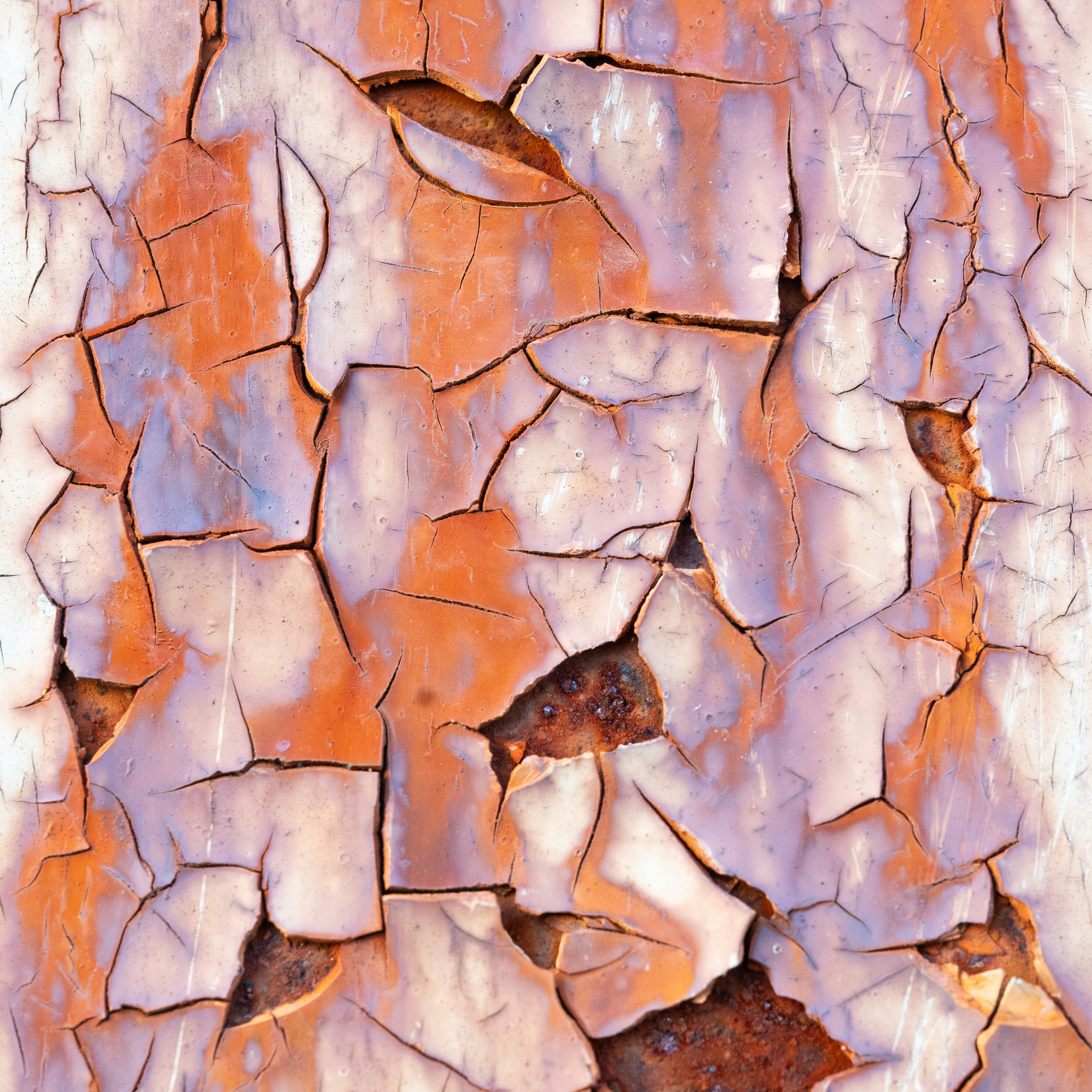
The cover and print edition come from Nonturn's own close-up photographs of the city — fragments of walls, surfaces and peeling paint found on walks through Tokyo. For years he has photographed these small abstract details, convinced the city hides painterly images in plain sight: the same method as the music, the city as material. The album cover is a square crop of the full 2:3 photograph. A small signed and numbered edition of 15, printed on archival Japanese washi; each order includes an album download code, made to order and shipped worldwide. Buy the print →
.png)
More of Nonturn's photographs of the city: @nonturn ›
Repeating Town
The city’s fragments repeat, overlap and resonate — a quietly grooving electronic landscape built only from field-recorded samples.
Every sound on Repeating Town was recorded in and around Koenji, Tokyo — traffic signals, footsteps, air conditioning units, construction, passing cars, fragments of speech. None of it is remarkable. These are the sounds a city keeps in the background, the ones you stop hearing. But this is not a documentary about Koenji.
The recordings are cut away from the time and place they came from, repeated, and layered. Fragments of reality are set into a different order, and while the grain of nonfiction remains, their meaning shifts: a world that does not exist takes shape.
The method is closer to the logic of paper cutting than to collage. Fragments of sound are cut from a single surface of reality and rearranged with their shape and origin intact. No matter how far they are processed, each one remains a footstep somebody walked, a vibration from a building, an event that actually took place at a certain hour. And the material here is not only sound. The time and the place each sound belonged to are material as well.
Sampling, here, is not a technique for reusing existing recordings. It is also a refusal to leave the starting point of music entirely to sounds that were designed and manufactured in advance. A city holds sounds that belong to it alone, each one tied to a particular time and a particular place. A signal, a footstep, the drone of an air conditioning unit — none of them can be produced again under exactly the same conditions. This music is built out of fragments that happened once.
All seven tracks unfold within a shared time of 96 BPM. That time carries over from the previous album, Territory. The tempo follows the rhythm of lived time: walking, stopping, waiting at a signal, walking on. Because they share that time, sounds recorded in different places can coexist in one flow, and the tracks interlock while remaining separate. As a DJ joins one track to the next to make a continuous stretch of time, the seven landscapes become a single miniature world.
Repeating Town remixes the reality of the city in a post-club grammar. It is also a practice of not entrusting the starting point of music to off-the-shelf instruments and existing formats alone.
Credits: All music, artwork, mastering and photography by Nonturn (Nozom Yoneda).




Tracklisting:
- Indicate
- Atonement
- Repetition
- Stagnant
- Fathom
- Disrupt
- Perpetual
Video - making the sounds' origin visible
Each sound on the album was recorded together with real footage of the moment it was captured. A2MVE — a custom Ableton-to-video application developed specifically for this album — reconstructs that footage from the structure of the session itself: which sounds are active, when, and how many at once. When sounds overlap, the city divides on a split screen; when the music repeats, the image repeats with it. Nothing is generated; every frame is real footage. AI was used not to create images, but to help design the editing rules and extend the artist's editing process to a density that would be impractical to cut by hand. An Ableton session edits the city.
Nonturn
Nonturn is the experimental music project of Nozom Yoneda, a composer born in Kanazawa and based in Tokyo. He takes the sounds that already play in everyday life as material, and by repeating and editing them, raises them into music — connecting a post-club editing sensibility with field sampling.
He debuted on a UK drum'n'bass label in 2004 and, through club and electronic music, moved toward his current sampling-based practice. On Audiobulb Records he has released Territory (2018) and Jellybeans (2023); Repeating Town (2026) is his third album.
His work extends beyond music into film and spatial audio. He scored every episode of the NHK Educational series Mitateru Forze (Prix Jeunesse 2024, Best Prize and others) and composed for the Osaka Healthcare Pavilion at Expo 2025 Osaka, Kansai. In recent years he has developed A2MVE, a self-built application that syncs the footage filmed at the moment of recording with the structure of the music, working across sound and image.
Reviews
Selected quotes in response to Repeating Town
"A dada-esque reconstruction makes art from the repetitive chaos of the city routine."— Musique Machine (5/5), Paul Casey
"Teases at EDM while dragging its dress through ambient puddles."— Musique Machine (5/5), Paul Casey
"Underlying this often pleasant and understated rhythm of the concrete is the idea of 'how the city can be made to function as music'."— Monolith Cocktail, Dominic Valvona
"This is not the city illustrating music. This is the city being made to play it — and it sounds like the finest orchestra."— Anxious Magazine, Artur Mieczkowski
"It is hard not to notice that music like this is already there. We simply never have time to really hear it."— Anxious Magazine, Artur Mieczkowski
"By condensing the city's noise into a rhythmic pulse of 96 BPM, Nonturn finds order within chaos."— Loop / Música Marginal, Guillermo Escudero
"Repeating Town reveals that our surroundings also have a life of their own."— Loop / Música Marginal, Guillermo Escudero
"Glitches and trilling synth loops, whirring buzzes and the occasional explosive blast."— Aural Aggravation, Christopher Nosnibor
"The city does not serve as the motif, but as the material."— African Paper
"A poetic ode to contemporary musicality."— Silence and Sound, Roland Torres
"A distorting, multifaceted mirror to the repetition of our world. Fascinating."— Silence and Sound, Roland Torres
Bandcamp Daily - The Best Field Recordings on Bandcamp, August 2026
Field recording can be more or less musical, ranging from pure nature recordings to edited, composed pieces. Nonturn’s Repeating Town pushes the limits of the latter end of the spectrum, using bits of recordings of Koenji, Tokyo to create an electronic groove that isn’t immediately recognizable as sounds of the city. Nozom Yoneda, aka Nonturn, walked around Tokyo recording everyday life, focusing on repetitions (traffic signals, footsteps, machinery). At the same time, he took video of each occurrence. He then composed Repeating Town by sampling his recordings and snapping them to a 96 BPM grid. Meanwhile, Yoneda used Ableton to match the sounds to their respective video snippets so that a mosaic of images is generated in time with the tracks. The daily, hourly, and even minute-by-minute repetitions of city life are made manifest for our eyes and ears. As music, Repeating Town is a great, glitchy electronica album; as a field recording, it’s a fantastic exploration of the rhythms of the city.
Original > HERE
Anxious Magazine - Interview
Nozom Yoneda / Nonturn – Even after I’ve lost everything, I’ll still have music
Nozom Yoneda is a composer and musician based in Tokyo whose work spans film, television, and advertising music, as well as sound design and experimental projects. His practice moves between classical, jazz, electronic, and club music. He began his career in the drum’n’bass scene – in 2004, he made his debut on the British music scene, releasing his recordings on several labels. Over time, he became increasingly interested in sampling, field recording, and ways of working with sound detached from its original source.
Under the name Nonturn, Yoneda has developed his own, much more rigorous approach to working with sound, in which traditional instruments are replaced by sounds from the environment. His debut album, Territory (2018), was created exclusively from environmental recordings made over several years on the streets of Tokyo; Jellybeans (2023) used hundreds of samples from sound libraries; and Repeating Town, released in 2026, returns to recordings from Tokyo’s Koenji district. The sounds of the city – signals, footsteps, cars, air conditioners, construction work, and snippets of conversations – are cut up, repeated, and arranged into a musical structure governed by a tempo of 96 BPM. The same attention to urban detail is also evident in his photography, in which Yoneda focuses on abstract fragments of urban surfaces.
Repeating Town is an album that particularly fascinated me – both for its approach and for the way it transforms seemingly ordinary city sounds into a precise, captivating musical form. This fascination led to a conversation with Nozomu Yoneda about listening to the city, working with field recordings, limitations and systems, and how sound can change our perception of our everyday surroundings.
Artur Mieczkowski: Could you tell us a little about your beginnings? What first drew you to music, and when did you realize that creating sound was something you wanted to pursue seriously?
Nozom Yoneda: My earliest memory. I must have been somewhere between two and four. My father was an architect, and he would work late into the night in his study at home. When I went in to play with him, he’d put a record on for me instead. There were these enormous speakers—Technics SB-7000s—that looked completely out of place in a room that size. And out would come Pictures at an Exhibition by Isao Tomita, Japan’s synthesizer pioneer. It’s from 1975. Of course, I only learned all this later, but Mussorgsky had written the suite after visiting a memorial exhibition of a painter friend’s work, and Tomita rebuilt it as pure electronic music on a Moog III P: a huge early modular synth, nicknamed a “chest of drawers”, that cost ten million yen at the time—around twenty-eight thousand dollars at the old rate of 360 yen to the dollar. To me, it sounded like an orchestra built entirely out of synthesizers. I’d squeal with delight and keep asking him to play it again and again.
Looking back, that was where my longing for unreal worlds of sound began.
Eventually I took piano lessons, then guitar lessons. When I was sixteen, my father said, “Apparently people make music on PCs these days,” and foisted an old computer and a sound module on me. He’d been an early adopter of CAD and believed in working with the latest tools, so naturally he must have wanted me to do the same. He was the one who played me Tomita, and he was the one who thrust the tools for making something like it into my hands. I reluctantly started learning the basics of sequencing. Around then, I was beginning to feel something like a resolve to become a musician. Judging by how quickly I was learning, I had this feeling, this strange confidence, that if I kept going, I wouldn’t fail.
A.M.: You started out in the drum’n’bass scene before moving towards more experimental forms of music. What were you looking for in experimental music that you hadn’t found in your earlier experiences? What actually prompted this change?
N.Y.: I actually started out studying jazz. Never did become a player, though. I gradually became interested in free improvisation and noise, but I began to feel they were just about pleasure, rather than building anything, so I started composing. (Of course, these days I like to think I understand the significance of the ideas behind that avant-garde music.) And that was when I came across drum’n’bass. It was a time when the world was starting to dance to jazz-like drumming and modes. I was drawn to how far ahead it seemed, and spent about eight years learning the craft. That led to a few records on British labels.
But gradually I got fed up with the way everyone in club music seemed to fall into line, and I grew more and more distrustful of it. Making the tracks DJs needed, the stagnation of everyone using the same kinds of sounds, endlessly preparing offerings for the top monkey on each scene’s little hill—there were plenty of reasons to want out. But the biggest problem was me. I didn’t have enough faith in the genre. And I didn’t have the talent to come out on top in that competition.
There was a side effect, too. Afterward, I got stuck with this image as a drum’n’bass composer, and more and more commissions were asking for that sort of thing. It became a problem. People had me down as the hardcore beats guy, and I struggled to shake that image. I’m actually more drawn to music with a quiet pulse.
Basically, I approach what I do as a kind of training, trying to work through everything I’m not good at. What I like isn’t necessarily all I’m aiming for. Learning rhythm properly early in my career really changed my life and my music. Rhythm is absolutely the foundation of music. Without it, you can’t make a melody, and without melody, harmony has no meaning. At least, that way of thinking has kept me going.
A.M.: At what point did listening itself become as important to you as making music? Was there a particular artist, album, or experience that changed the way you listen to sound?
N.Y.: After learning rhythm, I finally arrived at drones. It was a natural progression. Drumming ultimately becomes a drone. It’s a difference in granularity, in density. They both tap into the same kind of pleasure. I think you can get a feel for it by listening to the way the tanpura blends with precisely tuned percussion such as the tabla in Indian music. So I entered another long period of study. I thought about drones, experimented with them, followed them as far as I could, and gradually the world itself began to sound like a drone. Eventually I found myself heading out into the streets with a portable recorder.
Then your interests start to broaden. For example, I began collecting the sounds of outdoor air-conditioning units. I remembered where the ones I liked were, and kept going back to record them. Those units are drone-generating machines, and the city is full of them. What’s more, for some reason they often make beautiful harmonies. The reason is probably simple: the ones making unpleasant noises get repaired. The harshest sounds disappear first, leaving only the pleasant ones humming away in the city. A really good unit can conjure up a vast, desolate landscape. [laughs]
I liked the sounds of sewers too. A roar from underground, and the spacious sound of trickling water. That’s a good example of a sound you’re better off not knowing the source of. [laughs]
Come to think of it, I listened to a lot of Pauline Oliveros around then. What I like about Deep Listening is that it treats listening as an attitude rather than a skill. Incidentally, that album gives me the same sense of wonder I get from sewers. [laughs] When I went back to my family home in Kanazawa in 2005, she happened to be visiting Japan, and I found out she was performing at the 21st Century Museum of Contemporary Art. I went both days. I gave her a CD-R of my own drone music, and she accepted it with a smile.
A.M.: The Nonturn project seems to be based on a very particular way of listening to the world. How would you describe the relationship between everyday life and your musical practice?
N.Y.: At some point, everyday life began to feel like a monotonous loop, and I got this idea into my head that I couldn’t move forward until I noticed something. It’s close to that feeling in Edge of Tomorrow—in Japan it goes by the original novel’s title, All You Need Is Kill—of repeating the same day and dying over and over until something clicks. So for me, recording is a way of moving forward.
Actually, the title Repeating Town has a lot to do with the tedium of everyday life. There’s this reckless question behind it: how do you find a way to break through? And I always had a weapon in my pocket for doing just that. A recorder. If I sensed something was about to happen, I’d press record while it was still in my pocket, then whip it out like a gunslinger on the quick draw. I literally walked around ready to record at any moment. Even I think I was being a bit of a creep.
Have you read Hermann Hesse’s Siddhartha? He reaches enlightenment through insights drawn from his own experience, and the world begins to shine. The description of that elation is wonderful. On a good day, I can feel something like it. If you can be moved by everyday life and find joy in it, what more do you need?
A.M.: Your work often involves very simple elements or clearly defined rules. Why are constraints and systems so important to the way you compose?
N.Y.: Deciding on rules is the very act of creating. Maybe it’s easier to explain through photography.
Photography is about choosing things and leaving things out. What kind of people do you photograph? Or do you photograph landscapes without people? In my case, I didn’t want to photograph either people or landscapes. What did someone like that need a camera for in the first place? Well, anyway, by a process of elimination, I was left with walls. So what kind of walls did I want to photograph? What makes a beautiful texture? Traces of people’s lives, for example. Should you be able to tell what they are? If it’s better that you can’t, that narrows down the part you should frame even further. You’re constantly discarding things, and the rules you use to sort through them are what make you the photographer you are.
Music is the same. With Nonturn, I began by banning Western instruments mass-produced in the modern era, then went on to ban even the most primitive instruments. It’s also a kind of experiment to see whether music can exist without depending on any culture or civilization. And still, music emerges. In my case, though, I’m completely dependent on computers, so I suppose I’ve given the digital world a free pass.
Choosing 96 BPM is the same kind of rule. To avoid catering to techno in the 120–140 BPM range. That range doesn’t match the pace of the city I know. I wanted something between a walking pace—not a running pace—and a resting heartbeat. I felt that a pulse that was slow but still reasonably active would make it easier to portray people on a human scale.
But you lose a lot by making that choice, so I wouldn’t recommend it. Some degree of accommodation is necessary for music to be music, too. Taking away a shared language means shutting listeners out.
A.M.: Technology in your work is not simply a tool for recording or processing sound, but often becomes part of the compositional process itself. How important is the relationship between the human, the machine, and the algorithm to you? Can a tool at some point become a co-author of the music?
N.Y.: First, just to be clear about the facts, I didn’t use generative processes or algorithmic composition on any of the three albums, Territory, Jellybeans or Repeating Town. Every choice of material, every edit, was decided by my own ears.
Of course the answer is yes, but before I get to whether a tool can become a co-author, let’s think again about how music came into being. Civilization developed alongside tools, and music evolved with it. Printing technology changed music too, and computers, further along that same trajectory, took it into another dimension. In other words, whichever way you look at it, music has always depended on tools.
With that in mind, I’m certainly not opposed to technology becoming part of composition. I believe that if new music is going to emerge, it will come through a digital revolution. The internet has brought people closer and opened up opportunities for collaboration, while AI is also moving in the opposite direction, toward making connections with other people unnecessary. I’m open to both.
My own process is quite analog. Generally, I go out on foot and record my material. But Jellybeans, from 2023, was a side project within Nonturn. It was made during the pandemic, so I bought 60 sample libraries made around the world and built the album using only 500 sounds selected from them. I still haven’t quite let go of that approach, by the way.
AI is more like a very capable member of staff than a co-author. Bringing it in as a co-author isn’t a bad idea, but I won’t let it anywhere near the composition or the core of the concept. Those are the most enjoyable parts. The rest can be downright painful, so handing over everything outside the creative work has let me concentrate on composing more than ever.
One example is A2MVE, an application I made for Repeating Town. It stands for Ableton to Movie Export. It takes the structure of an Ableton session itself and uses it to reconstruct the footage I’ve shot around the city. For the series made from my street recordings, I’ve always recorded video at the same time. So there’s visual evidence for every sound. I decided what the video should show and how, and had AI write the code to assemble it into a single split-screen video.
Lately I’ve also been holding back on buying effects and the like. Instead of using off-the-shelf products, I’m making my own personal tools with code written by AI, to make music that’s even more independent. I’m sure the next album will take that idea further. I want to see what happens to my music when I let go of all those ready-made instruments and tools.
A.M.: Territory, Jellybeans, and Repeating Town were created using completely different methods. Do you see these albums as separate experiments, or rather as successive stages in a longer exploration of what composition can be?
N.Y.: I don’t think of them as separate experiments. They’re stages in a single search. To me, Repeating Town was very much a sequel to Territory. Even so, the sound has changed somewhat. It isn’t really a concept; it’s something more instinctive and intuitive. The degree of abstraction has increased. The same goes for my photography. Rather than concrete shapes, I’ve started looking for something expressed through shifts in the density of a vague, mist-like presence. More of a mood that won’t quite fit into words.
Then again, you can’t help being influenced by the times and whatever has been happening lately. However hard I try to limit my palette of sounds and distance myself from other cultures, as long as I’m hearing the sounds out there in the world, the times will find their way into the work. I wonder what would happen if I made nothing but my own music somewhere like a solitary cell.
Jellybeans might seem to have an unrelated concept, but it too is about sounds made by all sorts of people. The methods differ, but using the activities of many people as material is the one thing that connects all three albums.
I define Nonturn as a sampling artist. I forbid myself to write a score; I compose through technology—collage, or mosaic really: small fragments laid down until an image appears. I’m trying to prove that music with a universal quality can emerge that way. And underlying all of it is a post-instrumental stance. The aim is to create independent music, free from industrial or academic control.
Even after I’ve lost everything, I’ll still have music.
A.M.: In Repeating Town, the sounds of Tokyo are not simply a document of a place – they become musical material. At what point does a recorded sound stop being a document of a particular place and become something else entirely?
N.Y.: Again, it’s easier to think about this through photography. Most of my photographs are such close-ups that you can’t tell what you’re looking at. The moment you recognize the subject, the image becomes documentary and pulls you back into reality.
It’s the same with sound. I edit it so you can’t tell what it is. If you can recognize a sound, it’s because I want to use what that sound signifies.
And now I’m going to contradict myself, after spending all this time explaining how I’ve avoided ready-made instruments.
Something gradually became clear as I worked on editing the recorded material. What I’d been searching for out in the field was something like the sound of instruments. Instruments embody the sounds that human beings find pleasing. Even if you wiped humanity’s memory, the same kinds of instruments, with similar shapes, would emerge again. I built my palette of sounds by following what my body wanted, but what I ended up with was something that sounded just like instruments—similar, yet not quite the same thing.
A.M.: In Repeating Town, you focused on a relatively small area of Tokyo, and all the pieces are based on a tempo of 96 BPM. How does narrowing the geographical and compositional framework affect your creativity?
N.Y.: If you go somewhere unusual, you can record unusual sounds. But then you’re just borrowing the power of that place. Narrowing the area also means leaving yourself nowhere to escape. Can you find something on the same streets you walk every day? If you can, then something has started to change—your sense of what used to be a dull daily routine, your perception, your intuition.
Here in Koenji, there’s a festival called Awa Odori that draws around a million people over two days. It’s been running since 1957, and it’s now one of Tokyo’s biggest summer festivals. People play music together and dance the same steps. They find a sense of belonging in that rhythm. It’s wonderful that people of all ages can feel that connection simply by making a joyful racket in a shared language. In other words, once a year this town brings music into being with its own hands. A festival gives concrete form to a shared vision held by people who live within walking distance of one another, like a village community.
With pure computer music, though, it’s difficult to achieve that kind of physical presence or sense of place. That’s why media art puts so much effort into approximating it—building robots that make sounds, or projecting images onto things with projection mapping. In my case, I go out and record directly on the street to capture something concrete. It’s the exact opposite of what happens at a festival. Even after I’ve processed the sounds beyond recognition, the sound of the place remains. The sound of cars and the speed they travel at, warning signals, trains, people’s speech, the amount of space in the streets—sometimes a single sound is enough, but usually it’s the combination of all of them. It’s like orchestras having different lineups of instruments.
The biggest problem, I suppose, is that I’ve chosen a method I can carry out entirely on my own, so I can’t put on a festival. Even so, in terms of sheer numbers, the participants in my music are beyond counting. So many people are taking part without knowing it.
I fixed the tempo at 96 BPM to build a miniature garden of my own where I could connect my pieces like a DJ. The works in this series, going back to Territory, mix well together. It’s a modular miniature garden: different combinations can create new scenery and stories. This too shows that constraints aren’t just about giving things up; they’re a means of creating things, too.
A.M.: In your music, it is often difficult to identify the original source of a sound. How important is this loss of context to you? Do you want the listener to wonder, “What am I actually listening to?”
N.Y.: Sometimes I do want to make people think about it. For example, if you hear the rhythm of a child walking, and then an engine cuts across it, that alone can suggest danger. That’s a case where I want to use what the sound signifies. Conversely, I might want to mix the sounds of a construction site with an elderly person shoveling snow, using the sounds of people striking things to build a dynamic rhythm, without wanting to depict those people or that scene at all. So I control the sense of reality from one case to the next. Process a sound too much and it loses its power to signify; leave it untouched and its reality wrecks the music.
The basic aim of music is to let us see an imagined world, after all. I’ve always had trouble watching musicians perform. The image Saint-Saëns’s The Swan conjures up isn’t a person playing the cello, is it?
A.M.: It seems that chance plays an important role in some of your work, particularly when systems and generative processes begin producing results that you cannot fully predict. How much control do you want to retain over the final shape of a piece?
N.Y.: The biggest roll of the dice happens when I’m field recording. Working with an oscillator you can’t control is difficult, but there’s a lot to enjoy in it. Even if you go to the same place at the same time, you’ll never record the same thing twice. You go out to record the unpredictability of people’s actions intersecting. But once I’ve captured that chance occurrence, I keep editing until it becomes something inevitable. So for me, chance is a quality of the material, rather than the result. In fact, all of my music is under my control.
A.M.: You also work with photography, often focusing on ordinary urban details and surfaces. Do you see a connection between the way you look at the city and the way you listen to it?
N.Y.: I don’t make collages with photographs the way I do with sound. I present what I’ve photographed as it is. The subject is the street in both cases, but the way I make the work is completely different.
With photography, I’m capturing real chance. I walk every street and look carefully, so I can predict, to some extent, where that chance might land. Sometimes I can even pick up clues from the shape of the alleyways on a map.
Much of Tokyo was burned to the ground during the Second World War, and many of those areas were cleared and laid out in grids. Everything was reset at once, so the textures don’t carry the weight of history. You could say that the accumulation of time is the very essence of texture. So the places to go are the streets that look like animal trails. Even in the city, traces of old paths remain. Those places are alive, however narrow they are, and there’s always some small thing happening.
With recording, though, you can only capture the present, so history doesn’t come into it, and you don’t know what will happen or where. The sense of time is different. Photographing walls is like searching for drones that the city keeps radiating. They aren’t eternal, but time moves slowly through them. By comparison, street sound is far more photographic. After all, I spend my days walking so I can record that decisive moment.
A.M.: You also create music for film, television, and advertising. How does your relationship with sound change when you are working within someone else’s narrative or the specific requirements of a project?
N.Y.: When I’m working on a commission, I have my full hand of cards available as a composer. I grew up watching a lot of wonderful work on screen—I’m one of those people you’d call a cinephile. So I like to think I understand what the images are asking for better than most. I follow those needs and use everything I have to answer them. Sometimes you need an orchestra; sometimes you absolutely mustn’t use one. Being able to adapt and compose within whatever rules apply is the skill you need for soundtrack work.
In terms of my relationship with sound, it’s the exact opposite. Music for moving images has to communicate, or it hasn’t done its job. If it’s anxiety, you put in a sound that says “anxiety” instantly. In other words, I lean on what a sound signifies as hard as I can. With Nonturn, I edit in a way that unsettles those meanings, as if questioning them.
Here, nobody’s asking for anything, so I begin by forbidding myself things. I take away my ability to make certain sounds, then see what’s left. I’ve forced myself to play on hard mode with constraints of my own making. Outside work, I make a point of taking on new challenges and learning. I don’t do something if it’s only enjoyable and teaches me nothing.
A.M.: Looking at everything you have done so far as Nonturn and beyond, what are you still searching for in sound? Is there a question that keeps returning throughout your work, from one project to the next?
N.Y.: I wanted a kind of magical power to turn anything into music, and I’m still training to perfect that ability. But the music that comes out of it, although innovative, doesn’t seem to be something many people want. What I mean is, after all that training, the ability I’ve acquired might turn out to be as useless as bending spoons. So there’s certainly a need to find a way of applying it in a form that speaks to people more widely. Being original carries far too much risk.
Still, the desire to reach somewhere unexplored hasn’t dried up. Somehow, I want to find my way into a world I don’t know, one I’ve never heard before.
A.M.: Thank you very much for the interview, and I wish you the best of luck in carrying out your plans.
N.Y.: Thank you too. When I read your review Repeating Town, I was surprised to find things in it that I hadn’t yet been able to put into words myself.
In the future, I might start writing with instruments as Nonturn too. I’ve begun to wonder how much of my musical vocabulary I’ve been unable to express because I’ve been working without them. With instruments, I can say everything I want to say. If you can draw a detailed picture, do you need to insist on collage? What I mean is that, by clinging to this post-instrumental stance, I may be missing the music right in front of me that I ought to be writing.
So I also feel a need to reconsider the concept.
For example, I’d like to bring in lots of guest performers and edit their playing into a personal orchestra. In the end, I get lonely and bored making music that’s closed off and entirely my own. So I want to keep making work about people.
Original > HERE
LOOP Interview
The bohemian, countercultural neighborhood of Koenji in western Tokyo serves as the definitive sonic foundation for Japanese musician and sound artist Nozom Yoneda, performing under the moniker Nonturn. Stepping away from traditional instruments and digital synthesizers, Yoneda builds his artistic world exclusively from field recordings captured within the urban landscape. This is reflected in his latest album, 'Repeating Town,' released on 22 August 2026 by the British label Audiobulb Records.
His raw materials—later reshaped into distinct soundscapes and sonic fragments—are born from the acoustic signals of pedestrian crossings, the steady hum of air conditioners, passing footsteps, and drifting conversations in shotengai (traditional shopping streets), alongside the roar of traffic and construction sites. By editing and rearranging these ambient elements, Yoneda extracts hidden rhythms to establish hypnotic, repetitive beats, occasionally juxtaposing delicate birdsong with harsh mechanical noise. Under his touch, the chaos of the city ultimately dissolves into music.
These fragments of everyday life usually function as a repetitive backdrop to our lives, noticed only when the routine breaks down or is abruptly interrupted. This friction is precisely where Yoneda intervenes: he captures these ambient street sounds and deconstructs them, molding them into an entirely new musical framework. His work carries a resonant message: we must actively observe and listen, for even the mundane constantly shifts as it unfolds.
Special thanks to David Newman of Audiobulb Records for making this interview possible, and to Nozom Yoneda for generously sharing his artistic reflections.
'Repeating Town' carries a deeply evocative, cinematic title. What specific places, memories, or urban landscapes inspired the conceptual backdrop of this album?
"I live in Koenji, part of Tokyo with an unusually large number of shopping streets. Street after street is lined with small independent shops, and you can find everything there, from clothes to groceries to daily necessities. Unlike a shopping mall, each shop feels like it's run by a different person. It's a neighborhood that is still alive. With Koenji at the center, I explore the area I can reach by bicycle, roughly a five-kilometer radius. It's mostly residential, but now and then I also go to places like Shinjuku, where the office towers stand the way they do in any big city.”
"There are many reasons why I'm so attached to a sense of 'place', but with electronic music, the main one is to push back against a certain emptiness, the feeling of ideas conceived entirely at a desk. Music is a kind of fiction to begin with, so I want to somehow bring it down to earth and give it something concrete. But the world music depicts, while it's influenced by reality, is never limited by it. I take real facts as a base, combine them like a collage, and repeat them until a dreamlike “image appears.”
"The title has another meaning too. Everyday life is also a boring repetition, isn't it? We walk the same roads, say the same things, eat the same food. We are repetitive creatures. And yet, within that repetition, something slightly different happens every day. If you notice it and remember it, you can make something even out of a boring daily life. That noticing — a change in perception — is my real theme."
How has your sonic identity evolved from your earlier works to this current release? Did you approach the composition or production of 'Repeating Town' differently than previous projects?
"My consistent aim is not to make something that emerges from my own power alone, but to seek resonance with others — with crowds, with society — to assemble the sounds that come from them, and to make music in which many different consciousnesses exist at the same time. In the end, many artists make work that is about self-love. I hope to make work with a wider reach, one that looks a little more toward society."
"On top of that, what I worked on this time was erasing, as much as possible, anything that calls up the image of a human figure. It's a strange thing to say — I want to use the sounds of people, but I want the people themselves to disappear. On 'Territory' and 'Jellybeans' I kept a readymade way of thinking: showing things that were already there, evidence that human hands had been involved. My reasoning was that this would leave more to discuss."
But for a more abstract image, the biggest obstacle is being able to tell what a sound is. On the other hand, if you abstract too much, there's no longer any need for the sound to come from the city at all. It would be the same as playing it on a synthesizer. So I moved the project forward on the assumption that the right answer was 'something with only a faint trace of people.'"
You incorporate field recordings or found sounds into your tracks to build the atmosphere of 'Repeating Town'. Could you share an example of an unusual sound source used on the album?
"The sound you described in your review as a 'melodic synth' on 'Fathom' is actually a station's guide chime — an electronic chime that leads visually impaired people toward the ticket gates and stairs. I changed the key, but the melody is exactly the chime's own. It rings every day in the stations, and nobody listens to it as music."
"Another one: when my daughter was still small, we often went for walks together. Her footsteps and the sounds of her playing on the playground equipment, recorded on those walks, are used all over the album. On 'Atonement,' the sound you hear continuously, like a hi-hat, is my daughter walking. A small child's footsteps are a strange thing — the stride, the weight, the way the rhythm sways are completely different from an adult's. And since she has grown up now, I can never record those footsteps again. In that sense, I don't think there's a rarer or more special sound source.”
"That said, field recording with a child along was hard going. Leave her alone for a moment and she'd start singing or chatting (laughs). Children just can't stay quiet. But still, my music has a romantic side too — something like a remix of memories."
When listening to your music, it feels highly visual — almost like a soundtrack to an imaginary film. Do you visualize imagery or art while you are composing?
"One of my passing marks is whether a piece makes me imagine something visual, or some kind of shape. When I forget the material, technical side and start concentrating on the image the music projects, that's a sign it's getting closer to being music."
"Music takes a different shape every time you hear it, so people rarely talk about what it actually projects. That's where the value of a music video lies: it hands you an image. If the image is fixed, as if explained, the music becomes easier to consume, and it becomes something people can talk about together. But honestly, I think that's a waste. The image of music is formless and keeps changing, yet the moment you watch the video, the image settles into place."
"I made a video for this release too, but it isn't a music video. It isn't there to add an image — it's a split-screen documentary meant to convey the facts accurately. Whenever I record, I also film that moment. It's partly so I can keep track of my sources, but it's also evidence of what each sound was."
"Where a sound came from may not matter to the listener, but for some reason it matters to the person making it. What kind of guitar, made where; which maker's synth, from what era; which record the drums were sampled from. For me, these are sounds I picked up from the city, but every single one has its original resonance and a story I don't know. In the field recording projects I presented on 'Territory' and 'Repeating Town' , never using industrially made instruments is part of their identity.”
Now that 'Repeating Town' is out in the world, what concepts or musical directions are you eager to explore next?
"I don't think I'll stop making people my theme, but an album that completely rejects instruments is musically at a disadvantage, so I may move away from that. The first step might be to open things up to electronic sounds I make myself."
"It's a bit late to be saying this, but an instrument means the ideal sound has been made in advance, and that's a big advantage. A composer writing for piano starts from a trust that the piano will always sound good. In that sense, setting a musical handicap for myself is also a little ridiculous. Shouldn't I remove that limiter step by step? That kind of doubt is always crossing my mind."
"I'd like to decide on the next concept to take on while also weighing the difficulty setting. Or should Nonturn stay as a high-difficulty character, with instrumental music under another name? It's a tricky problem. A project name is like a company: it starts to take on a personality of its own and walks on its own feet, so changing its course is hard. Because I don't want to turn back."
Original > HERE
Radio Hoerer
There are those moments when the replay button just seems to get stuck. Amidst all the madness I'm listening to, it's perhaps this groove that I want to hear again and again. I'm talking about Nozom Yoneda, also known as Nonturn.
Listening to it, I can hardly believe that "Repeating Town" originated from field recordings. Nonturn has captured the everyday life of Koenji in Tokyo, with its inhabitants and all their repetitive cycles. Machines, footsteps, noises, rhythms—these everyday sounds of Koenji have been transformed, through electronics and sampling, into a fascinating urban life at 96 BPM. "Fascinating," Spock would say, and I definitely agree. Listen, listen, listen…
The fragments of the city repeat themselves, overlap, and resonate with each other – a gently grooving electronic soundscape consisting exclusively of samples recorded on site.
“Repeating Town” doesn’t ask what the city sounds like, but rather how to make the city function as music. Every sound on the album was recorded in and around Koenji, Tokyo: traffic lights, footsteps, air conditioners, construction work, passing cars, and snippets of conversation. These recordings are traces of real places, but they aren’t presented as documentary evidence or mood pieces. They are cut, repeated, layered, and set to a 96 BPM grid as sampled material.
The title hints at the method. The everyday city is already full of repetitions: signals return, footsteps pass by, machines hum, paths repeat themselves, voices appear and disappear again. Nonturn doesn't hear these repetitions as background, but as a musical given. Once removed from their original context, the sounds no longer describe their origin, but function as rhythm, texture, accent, resonance, and silence.
What matters here is not the novelty of using non-instrumental sounds, but the grammar that makes these sounds musically functional. Instead of documenting Koenji, Nonturn transforms it into a self-contained miniature world: the town is sampled, arranged on a uniform 96 BPM grid, and made to move according to its own internal logic. It is less a recording of a place than a private miniature city built from samples and played from within. In this sense, "Repeating Town" is closer to musique concrète in the style of club music than to an ambient soundscape: a post-club electronic work that emerges from the repeating surface of everyday life.
All seven tracks share the same pulse, connecting the album back to "Territory" as part of a continuous listening environment. While "Territory" stitched together the recorded streets of Tokyo into a single soundscape, "Repeating Town" adopts the same field-sampling method and arranges it around this steady pulse—its grid-like and repetitive feel reminiscent of club music, but deliberately outside the "four-on-the-floor" logic of techno. The cover and print run are taken from Nonturn's own close-up photographs of the city—fragments of walls, surfaces, and peeling paint he discovered on walks through Tokyo. For years, he has photographed these small, abstract details, convinced that the city conceals picturesque images right before our eyes: the same method as with the music, the city as material. A small, signed, and numbered print run, produced on Japanese washi archival paper, is available here.
Original > HERE
African PaperWith "Repeating Town," Nonturn will release his new digital album on August 22nd via Audiobulb. Behind the project by Tokyo-based composer Nozom Yoneda lies a fascinating concept: all the album's sounds originate from field recordings in Tokyo's Koenji district, a trendy nightlife area that is actually part of the more affluent Suginami ward, but already hints at its proximity to Shinyuku. The sounds range from traffic lights, footsteps, and construction sites to air conditioners, passing cars, and snippets of conversation. No instruments are used.
“Repeating Town,” however, is explicitly not intended as a documentary journey through an unprocessed sonic “reality.” Instead, the recordings are deconstructed, looped, layered, and reorganized on a constant pulse of 96 BPM. This creates music that moves between musique concrète, microsound, and an electronic soundscape beyond the club scene, transforming the city itself into an instrument. Fittingly, the artwork and photographs are also by the artist. Close-up shots of weathered facades, walls, and layers of paint from the area reflect the same idea as the music: the city serves not as a motif, but as material. The project is complemented by specially developed videos (see Bandcamp) in which the original film footage of the field recordings is reassembled according to the musical structure.
Original > HERE
Musique MachineLife is full of repeating patterns and cycles, be they from the Earth and Moon, our natural beings, or those we create in our day-to-day. Extend this out, and one can see a city come to life, following its own patterns and cycles, built upon thousands (or more) simultaneously running and moving cycles of its denizens. Nonturn takes these repetitive city cycles, repurposes their sounds, and structures them into a new, 96 BPM cycle for Repeating Town. Capturing the machines, footsteps, sounds, and rhythms of Koenji, Tokyo, Nonturn builds an intriguing new city life via experimental electronic music. Rearranging the recorded sounds to form something musical from nothing, this dada-esque reconstruction makes art from the repetitive chaos of the city routine
Spread over seven tracks, the 96 BPM grid connects each piece like the cycles and patterns repeated each day by the denizens and district of Koenji. This grid, though, is just a reference point for the cycles, and the BPM listing may make one think this is dance music in some way. One would better liken it to a pulse, a heartbeat that makes the city tick, each beat another contraction moving the traffic forward. This interconnectedness helps keep Repeating Town cohesive as well as furthering the motif, not to mention giving the album a pulse and life of its own. WIth as much field recording as Repeating Town contains, Nonturn keeps it from sounding mundane and like a street recording with a beat. Lids slam, cars rush past, machines hum, but even the discernible city noises get new life on this album. The pacing keeps the album moving, as is the point of the project, but remains aloof enough to allow the sounds and loops to remain at the forefront, not the grid itself. Coming from the speakers, the sounds display a new look at Koenji, a secret view greater than the sum of the parts. Knowing how the album was made helps the listener to contextualise it in this way, but if one were to listen fresh, they'd find a very engaging electronic album that teases at EDM while dragging its dress through ambient puddles. Like the din of the city routine, one makes of it what one will, and each experience will be different.
Nonturn's Repeating Town takes an interesting approach to capturing the mundane cycles of city life and transforming them into something different and beautiful. Keeping the repetitive, cyclical nature with each piece, the album moves from track to track as one would go about their own day, becoming a being of its own. Repeating Town is full of engaging layers and loops, and like the cycles it is based upon, when the album ends, one will hit play and start it all over again.
Original > HERE
Monolith CocktailUnderlying this often pleasant and understated rhythm of the concrete is the idea of “how the city can be made to function as music”. Beats and loops created from the environment and resonance of Tokyo’s famous “bohemian” neighbourhood of Koenji are repeated, layered and placed on a 96 BPM grid and used as the basis of sampled material, with the results being a most ambient and minimal soundtrack of kinetics, soft industrials, reverberations and the tubular.
The alias of Kanazawa-born and Tokyo-based electronic composer Nozom Yoneda, the Nonturn project utilizes everything from the tools of construction to the traffic and architecture of a well-known musical underground (especially punk rock it’s said) and retail district in the Western regions of that metropolis. And all of it without the use of instruments, nor the obvious or familiar sounds of a buzzing city; transformed from their sources into a low rhythm and groove and set of looped or sampled sonics and ambience.
Every track is interesting in its style and mode of rhythm; from cupping sounds to the ringing of metallic reverberations, swept motions, scaffold and the warbled oscillations and vibrations and the pneumatic drills of machines. With some exceptions it makes for a softened post club absorption of Boards of Canada, Kriedler, Japanese Environmental music, and the early Warp label.
Those exceptions however, can be found in the form of the camera-like shutter snaps hollowed-out tubed captures of ‘Fathom’, and on the psychogeography of the industrial and more supernatural sounding ‘Disrupt’ – I’m convinced that the spirits of the district’s original temples, of which it is named after, are invoked through the mystical and spirit sounds that prick the metallurgy of the slab concreted exteriors; something seeping through from the back alleys in which the old has been hidden and rebuilt. The peeling of layers, of the daily actions and converse of a city district come alive through attentive and subtle uses of sampling and the transduced to create a most immersive sound world that grooves and rhythmically finds a connection with the concrete.
Original > HERE
Anxious MagazineThe city is rarely, if ever, silent. Its surface is in motion—signals, footsteps, fans, cars, distant voices, construction. We usually hear them as background noise, a meaningless hum. Nonturn does the opposite, stripping these sounds of their documentary function and examining what happens when they are treated as musical material.
Repeating Town was created entirely from field recordings made in Koenji, Tokyo. There are no traditional instruments. Chopped samples are subordinated to a 96 BPM rhythmic grid, repeating, overlapping, and colliding. Footsteps become percussion, a mechanical hum becomes texture, a random click becomes accent. It's not the city that illustrates the music. It's the city that's forced to play it, and it sounds like the finest orchestra.
What's most interesting is how quickly the recordings lose their original meaning. While a single sound can still be recognized as a fragment of the street environment, when combined with subsequent samples, it begins to fulfill a purely musical function. Footsteps, signals, and the operation of devices are reduced to rhythm, a brief accent, or a repetitive texture. Nonturn, therefore, doesn't attempt to recreate a specific location, but rather utilizes its characteristic, recurring elements to create its own structure.
Repeating Town doesn't tell the story of any specific location, though it uses only one—Tokyo. In these recordings, the city loses its obviousness, as if someone had erased its geographical coordinates. Over time, the origins of individual sounds cease to matter. How they function within the new structure becomes more important. It's a bit like looking at a section of wall taken out of context; suddenly, it no longer resembles architecture, but an abstract shape. Nothing here is invented, yet everything changes function.
"Repeating Town" has a touch of musique concrète infused with the experience of club music. The steady tempo gives the whole thing a "danceable impulse," but instead of synthetic sounds, the materiality of everyday life emerges. This isn't a simple attempt to "make a beat" from street sounds. Nonturn is more interested in the moment when sound ceases to be information and becomes a physical event. Then, the hum of an air conditioner can have the weight of a bass, a transition signal the function of a hi-hat, and a random conversation becomes an almost abstract murmur.
It's here that the album comes closest to post-club thinking. Rhythm isn't solely used to organize time, but allows for the perception of regularity where chaos seems to reign. 96 BPM becomes a kind of scaffolding on which Nonturn suspends fragments of reality. Repetition, however, doesn't mean monotony. On the contrary, subtle shifts, sample overlaps, and variations in length keep the structure in constant, almost organic motion.
Repeating Town isn't a classic field recording album. It's more like an attempt to find musical logic in what usually slips under the radar. Nonturn records the city, but makes it repeat its own gestures like a rhythm. And when, after listening, we return to our own street—to the signals, footsteps, the monotonous hum of machines—it's hard not to notice that similar music is already there. We simply don't have the time to truly hear it in our daily lives.
Original > HERE
LoopAccording to Yoneda, his alias means “not to turn back” or “not to go around.” This philosophy is reflected in a musical approach based on infinite loops that always project forward.
His third album, “Repeating Town” —released on August 22, 2026, by the British label Audiobulb—is constructed from field recordings of Tokyo and digital processing. The core of this experimental project is repetition, understood not only as a musical device or a danceable rhythm, but as a reflection of the routine and dynamics of the urban soundscape.
Thus, the daily commute, the traffic lights that change with mathematical precision, and the constant hum of air conditioners are transformed into loops. By aggregating urban noise into a rhythmic pulse of 96 BPM, Nonturn finds order within chaos, achieving a predictable and hypnotic effect on the listener that also functions as a live mixing tool for the DJ.
This album possesses a strong tactile and percussive component, manifested in the striking of objects of various origins, as well as in clicks interrupted by birdsong, as in "Indicate," the opening track. Meanwhile, "Repetition" features diverse machine noises interwoven with the indeterminate vocals of "Stagnant," while a dry, metallic strike marks the rhythm.
Over “Fathom” glides a layer of synthesized melodies and loops, while percussive sounds and the sound of a photographic capture flow effortlessly. However, in “Disrupt” we find only disjointed recordings and microscopic sonic fragments that never fully develop. Finally, in “Perpetual,” various brief recordings enter an endless loop that echoes the concept of repetition.
Nozomi Yoneda presents us with an urban soundscape that evokes the daily life we are immersed in, whose noises and sounds often go unnoticed. However, with "Repeating Town," she reveals that our surroundings also have a life of their own.
Original > HERE
Aural AggravationEvery town, every city has its own unique vibe. Some we acclimatise to, others, we find uncomfortable. Others still, scary. Myself, I am not a fan of big cities, but have always felt comfortable in Leeds, but always feel on edge in Manchester. I can’t explain this. apart from the fact it’s rained almost every time I’ve been in Manchester, I’ve never had a bad experience there. In fact, I’ve had many positive experiences there, but still just feel something… it doesn’t sit with me, and I can’t settle. My experience of ‘international’ cities is limited: the only time I visited New York was when I was three, and beyond that, I’ve only been to London and Paris. I’m not sure Nicosia counts, being international in a different sense, and I expect that that’s perhaps another discussion altogether – although, for what it’s worth, while my fellow conference delegates proffered their passports to venture through the military checkpoints to cross the border into the Turkish territory to enjoy a meal, I remained in the pub in the Greek side of the Old Town with a book while I awaited their return. I have no regrets about this seven years on. But I digress. Every city has a feel, and not just a vibe, but a vibration. And big cities are in essence the same as smaller cities when you’re there, since they’re divided into various communities, segments, quarters, districts, whatever.
Nonturn’s Repeating Town is a work which is an assemblage of sound which captures, one way or another, the essence of Koenji, Tokyo. This is quite specific, and only highlights my observation that large cities are generally comprised of zones and areas within, and this is true of Koenji, which – and I make no apologies for turning to Wikipedia for into here –‘was largely unaffected by the 1980s building boom and therefore many of the houses and shops in the area are small and reflect the character of ‘pre-boom’ Japan. Due to its aging retail district and location on a major commuter route, the station area has become a center for small restaurants and ‘Live Houses’ which offer live music.’ It sounds pretty cool on paper.
Precisely how representative Nonturn’s Repeating Town is, I can’t really say. However, as Nozom Yoneda, aka Nonturn explains, ‘Every sound on the album was captured in and around Koenji, Tokyo: traffic signals, footsteps, air conditioners, construction, passing cars and fragments of conversation. These recordings are traces of real places, but they are not presented as documentary evidence or atmosphere. They are cut, repeated, layered and placed on a 96 BPM grid as sampling material.’
He goes on to add, ‘The title points to the method. The everyday city is already full of repetitions: signals return, footsteps pass, machines hum, routes repeat, voices appear and disappear. Nonturn listens to those repetitions not as background, but as a musical condition. Once removed from their original setting, the sounds stop describing where they came from and begin to act as rhythm, texture, accent, resonance and silence.’
Repeating Town contains seven pieces, each around five or six minutes long and each of which pulls together a host of drones and clanking percussion, interwoven with weird electronica. At times is ripples and weaves, art other, it jogs, picking up pace and evolving technoindustrial beats as it does so. Field recordings aren’t particularly apparent at in this hybrid of mixes, and as tone and texture from other sources build, there’s a creeping discomfort which builds. It’s an album which is built on glitches and trilling synth loops, whirring buzzes and the occasional explosive blast which disrupts an otherwise smooth surface. But there are whirring dentist drills and all sorts, all seemingly looped together and otherwise spun into a strange, soporific blend.
Original > HERE
Silence and SoundWith Repeating Town, Nozom Yoneda, aka Nonturn, creates a work of fragmented urbanity, composed from field recordings captured in and around the city of Koenji. The sounds used here are derived from recorded images and directly connected to an Ableton system specially designed for the album. The whole thing is rearranged into a pulsating 96 bpm beat, evoking more a journey through the back rooms of a club during the comedown than a cerebral ambient work.
Nonturn captivates with its ability to compose an album of cinematic musical power, without the use of any instruments, giving birth to a poetic ode to contemporary musicality. We are immediately drawn into a universe where fragments form worlds of intoxicating immediacy, catapulted into a swirling universe where our daily lives take on a connected dimension with an elsewhere of quantum possibilities.
Repeating Town offers a distorting, multifaceted mirror to the repetition of our world, concentrated in a space-time continuum where only emotions matter, making us forget the complexity of an environment constantly bombarded by diverse and varied noises. Fascinating.
Original > HERE