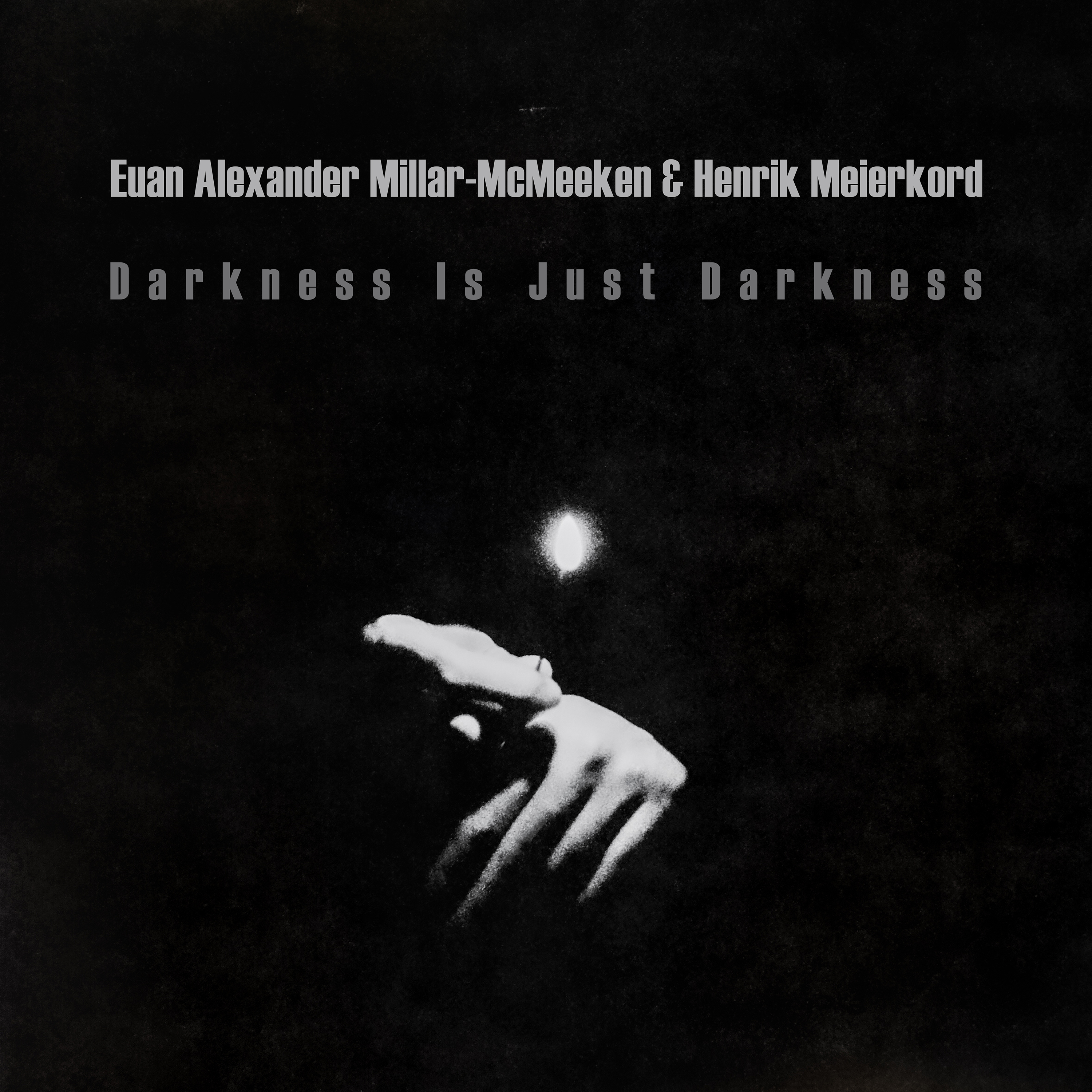
Darkness Is Just Darkness
Darkness Is Just Darkness is a collaborative album by Euan Alexander Millar-McMeeken and cellist Henrik Meierkord, presenting a stripped-back convergence of ambient music and spoken word. Intimate and unembellished, the record unfolds at a measured pace, allowing texture, silence, and language to carry equal weight.
The album’s music is written and constructed by Millar-McMeeken, whose previous work has consistently explored minimalism, repetition, and emotional directness. Here, those concerns are pushed further inward. Synths, drones, and understated harmonic shifts provide a fragile framework for Meierkord’s cello, which moves between sustained tones, uneasy scrapes, and mournful melodic fragments. Nothing feels decorative; every sound exists in service of mood and meaning.
Spoken passages—delivered in a plain, conversational register—recall the early work of Arab Strap, favouring restraint over drama and observation over narrative resolution. The words sit inside the music rather than on top of it, dissolving into the arrangements and re-emerging as another texture. The overall tone is reflective rather than confessional, suggesting accumulation over explanation.
In keeping with Millar-McMeeken’s broader catalogue, Darkness Is Just Darkness resists genre certainty. It shares an affinity with the slow-burn atmospheres and emotional patience associated with releases on Kranky yet remains grounded in a distinctly personal voice. Where earlier projects hinted at distance and abstraction, this album feels closer, quieter, and more resolved in its refusal to offer easy conclusions.
Rather than framing darkness as something to transcend, the album treats it as a neutral state—something to sit with, observe, and understand. The result is a record that rewards close listening and time, offering a space where ambiguity is not only allowed but essential.




Tracklisting:
- The Evening Seems So Distant
- All One Breath
- Shades Of Night
- Where Morning Broke
- Are You Restles
- Silence In The Dark
- An Hour Before Dawn
- Memory
- A Little Part Of This In Everyone
Euan Alexander Miller-McMeeken & Henrik Meierkord
Euan Alexander Millar-McMeeken is a multidisciplinary composer and artist known for projects under names like Glacis, Civic Hall and Yoal. His work often combines experimental sound, recorded environments, and reflective personal content creating music that balances introspection with clarity, inviting listeners into richly textured sonic spaces.
His work delves into darker, more experimental territory, focusing on mood, texture, and emotionally charged songwriting. His music stands as a progression shaped by exploration, honesty, and sustained creative growth.
Henrik Meierkord is a Swedish musician based in Stockholm, experimenting with different genres. With the cello as his main instrument, he also masters viola, double bass, guitar and numerous other instruments. Typically Henrik’s approach to composition tends to begin with the cello, before further layers of strings are added, such as double bass or violin. But often, he will create music intuitively and free from set rules; sometimes a piece of music can be started with a synthesiser or piano or written purely as an experiment.
As a composer, Henrik creates vivid, full-bodied pieces that draw as much from ambient music's meditative qualities as they do from humanity's rich history of classical styles. As a cellist, he injects emotion that is both relatable and intimate, across a diverse range of musical collaborations. With a work rate that is nothing short of astounding, Henrik continues to explore every possible expression of human feeling, from the heart-wrenching to the transcendental. And yet, a lightness and curiosity run throughout his process, with the sole aim to bring true benefit to the listener. His keywords in making music are pause, vacuum of time, the unconscious, consciousness, dream, meditation, a way of avoiding direct thoughts and reality. He combines Neoclassical approach with his string instruments and effects and sometimes together with synthesizers.
He has also previously released music on labels such as Ambientologist, Audiobulb, Projekt records, Ella ruth Institute and Subcontinental Records. Henrik began playing cello aged of 12, progressing to play in classical orchestras, onto performing in bands and then creating his own music. He has also collaborated and performed for artists such as Ossler, Pawel Kobak, Marco Lucchi, Meipr, Sole, Strulgattu, Agent Side Grinder, Knivtid and many other collaborations.
Video by Ralf Moussa
The narrative takes on the process of ice melting during this time of the year. As in both realistic and abstract notions and forms, the visual aims to
embody a parallel from the geological nature on how ice melts. How the war blowing into my country Lebanon has exposed bigger areas of debate on notions of not only morality, but strength of character, opinionation, distress and relief. Where this visual work exposes the chaotic in correlation to order.
Silence in the Dark resolves, in one having the same attributes in the shadows as for under the spotlight not keeping no war alter ones character between war and peace. Noise and calm. The same thought/deed orientation. In colour as in dark black and white.
Ralph Moussa – www.ralfmoussa.art
Reviews
Moonbuilding
I’m a big fan of Euan Alexander Miller-McMeeken. You should be too. I’ve been writing about him for a little while after being pointed in his direction by Alex over at quiet details. Here’s the skinny if you’re playing catch up. It all circles around Euan’s own Sleep In The Fire label. There’s a debut album, ‘All The Weather Of The Human Heart’ from June 2024, which we called “a gentle whisper of a record”. There’s ‘Framed Insects’ from last May, of which we said, “the songs sit on top, but underneath there’s pops and crackles like you’re playing it on over-loved vinyl. There’s electrical buzzes everywhere, and fizzes and hums”. In between those two releases there was a collaborative record with US-based multidisciplinary artist Jesse Narens as Bird Battles.
There’s a theme developing here. Artist album, collaboration, artist album… it’s time for a collaboration! On ‘Darkness Is Just Darkness’, Euan teams up with Stockholm-based multi-instrumentalist Henrik Meierkord. Those instruments include cello, viola, double bass, guitar and, apparently, many more. And the genres he works are multiple too. There’s some helpful tags in the accompanying notes – ambient, electronic, psycho-acoustic, microsound, modern classical. I must look up microsound, I think I would probably like that.
‘Darkness Is Just Darkness’ is described as “a stripped-back convergence of ambient music and spoken word”. I like that it’s described as resisting “genre certainty”. It’s ambient like Field Lines Cartographer is ambient. It has the feel of one of those film soundtrack albums that sits on its own, separate from the film. Like ‘Paris, Texas’ or ‘Birdie’. There’s dialogue throughout, which only adds to the cinematic vibrations.
The spoken work comes in a gentle Scottish burr, which I assume is Euan. It reminds me of Bill Drummond’s spoken word section in The KLF’s ‘Build A Fire’. “We’ll stop for lunch / In some taco bar / Lee Marvin on the jukebox / Wandering Star’. Except musically this is very much at the other end of the spectrum. Underneath the spoken word on opener ‘The Evening Seems So Distant’ there’s a background of radio interference, distant shortwave chatter, a fuzz of white noise, with minimal piano and heaves of cello. The noise builds to quite a crescendo before it clicks off leaving just the delicate music. On ‘Are You Restless’ there’s even some singing. Sort of singing. It sounds like a fever dream or a blurry ‘Twin Peaks’ reality. It’s really tinny, distorted almost.
Henrik’s contributions are always equal to the challenge and lend a richness to the sound, as strings tend to do. The notes talk about how the music lends “a fragile framework for Meierkord’s cello, which moves between sustained tones, uneasy scrapes, and mournful melodic fragments”. It’s at the fore on ‘When Morning Broke’, the cello dancing over a sustained deep drone, but everywhere you look/listen you’ll hear it. I like the crackly closer ‘A Little Part Of This In Everyone’. I’ve said this before about Euan’s music, I think it’s my old speakers playing up, but it’s not. I love that. This is excellent, which is rapidly becoming the default setting for Euan Alexander Miller-McMeeken.
Original review > HERE
Igloo Magazine
here is no need to be afraid of the dark. It’s just darkness. Sometimes it needs to be explored to be better understood. I don’t know who first came up with the word endarkenment, but it’s a word I think of when listening to this record. Not as some kind of antimonial left-hand path that sets itself up as something sinister, but just as a willingness to turn within and examine all the stuff that isn’t so fluffy and feel-good. I suppose therapist types and latter-day Jungians might call such an internal examination shadow work. This album sounds like shadow work to me, and in looking at the shadow finds something truly beautiful.
It’s elegiac in mood as one might expect if you’ve listened to other music by Euan Alexander Millar-McMeeken, or the contemporary studio-chamber experimentation of Henrik Meierkord. Here they collaborate together for the first time after Millar-McMeeken sent Meierkord some initial recordings. The cellist was blown away by what he heard and wanted to come in as a full collaborator. What emerges is a stark sense of loss, where what is absent hovers around the notes, even as they fill up the void with a somber passion. Yet there is a beauty there in the dark, something comforting and tangible to hold onto amidst the sorrow.
In the first piece, radio junkies like myself will delight in the fascinating static of the first song, with its snippets of broadcasts and transmissions. Such samples appear across the album as a whole, but they are used sparingly giving them depth. All the sounds have a proper place, and it seems the collaborators found the right place for everything.
The philosophical bent of the work comes out right away as Millar-McMeeken asks, “This music wants a proof of gods existence / let the ear attend / on the borders of your vision.” By the end I don’t know if the answers have been given, but certainly there has been catharsis in asking heavy questions and having deep talks.
This work could easily have sat in the realm of what some artists many decades ago would have called sound-poetry where the focus was on the sound of the words and the sounds that accompanied the words.
Music gives further weight to the visionary poetic insights into the human condition ::
It also reminds me of the work of American composers Robert Ashley and Laurie Anderson. They wrote music around their words, embroidering the spoken and the sung together into narrative tapestries where the emphasis was on listening to the words in a tradition that took its cue from opera. Yet they are disjointed narratives, offering snapshots and slices of life, where the music gives further weight to the visionary poetic insights into the human condition. Just as with Ashley’s work on Perfect Lives, or Anderson’s on United States Live, the voiced aspects of the album are in a “conversational register.” It’s like sitting with a friend as they pour forth a soliloquy to someone they know and trust. It is thus a privilege to be invited in as a listener to this intimate self-revealing.
Millar-McMeeken’s words here aren’t heavy on narrative but are full to the breaking with emotional weight, and yet they hover around the atmospheres of romanticist revelation conjured by Meierkord’s deft cello playing which flashes like a light to illuminate portions of the dark.
“All One Breath” consists of gentle drones and the weaving of Meierkord’s soul enchanted cello around a soft lengthening of tones that do make it sound as if it was all drawn on one breath.
Amidst all of this is a crepuscular sepulchritude of electronic abstract noise and instrumental passages where full attention can be given to the impeccable sound design. On the level of structural engineering, it’s another marvelous feat. There are so many subtle details in the electronic portion, while the acoustic elements often recall the languid melodies of ancient folksongs as on “Where Morning Broke.”
On the song “Are You Restless” the cello sounds tape warbled as if with vibrato, as do the piano parts. Little beeps, almost like the kind you hear in a hospital when someone is hooked up to all kinds of machines, key in their short little tones to punctuate the music. Eventually the monologue gives way to singing. The boundary between poetry and song has always been elusive, but here in the borderlands of musical sound art, and the borderlands of spoken word and singing, it shows and shines on that permeable line. He sings “I will give you everything” with such emotion you know the writing comes from some situation, whether real or imagined matters not, pregnant with tumultuous discord.
“The boundary between poetry and song has always been elusive, but here in the borderlands of musical sound art, and the borderlands of spoken word and singing, it shows and shines on that permeable line.” ~Justin Patrick Moore
Relief from that feeling comes in a heartbreaking musical resolve in the opening cello and piano phrases of “Silence in the Dark.” Usually that comes towards the pinnacle of a song, but here it is at the beginning, though forming a pinnacle of the album. There is a quietude and calm restraint to these passages as it now takes the listener back down into the valley of shadow. Darkness is thus a place of peace, of reflection, of coming back into oneself. In the light of the day all focus is external out into the world, yet here the focus is on the internal, a place of reflection, where even amidst the tumult, a way forward can be found. Burning distortion and fuzz coruscate off the strings as if searching for a place of rest and ease of heart.
The use of static, of what sounds like wind, of ruffling makes this a perfect accompaniment to autumn as the nights grow longer. Winter is yet ahead, but the darkness is just darkness. Nothing to be afraid of or to deny.
In “An Hour Before Dawn” the voice is multitracked again with the words of the disjointed narrative, the soliloquy to a friend late at night, perhaps after one too many whiskeys have been filled in the tumbler, and the deep stuff starts to come out from behind the walls and defenses we put in front of each other. A sung part weaves around this as ever does Meierkord’s playing which anchors the entire work.
On “Memory” bit-destroyed granular processes join with plucked guitar strings and bursts of fuzz and the slight hum, present in various songs throughout, of a gentle sustained drone. The notes are like feathers of a crow or a raven or some other black bird ruffled by the slow wind of utterance. The static crackles continue in the final song “A Little Part of this in Everyone,” where the final resonant emotional resolve is unfurled, unwinding to the final words and notes.
No need to worry as long shadows fall. No need to deny the dying of the light.
Original review > HERE
The Letter
Tamed and tempered darkness
Following their bleakly beautiful album We Gape and We Are Healed from earlier this year, Euan Alexander Millar-McMeeken (then working under his Glacis alias) and Henrik Meierkord are back with a second collaboration called Darkness Is Just Darkness. And it’s another dark album. With Millar-McMeeken’s creepy spoken words (think: a penitent Jigsaw with a Scottish accent) accompanying five of the nine tracks, it’s more mindful than contemplative but, like the Gaspar Claus release, Meierkord’s masterful cello playing offsets the crepuscular with a semblance of stark hope. And while the vocal tracks are noticeably grainier in comparison to the others, there’s a sense of space, vast and safe, prevalent in both that unites the disparate contributions; like scenes of a film, interchanging moments of contemplation and ongoing narrative. Light emerges from the gloom on closing track A Little Part Of This In Everyone when Millar-McMeeken’s words ascend to song.
Original review > HERE